
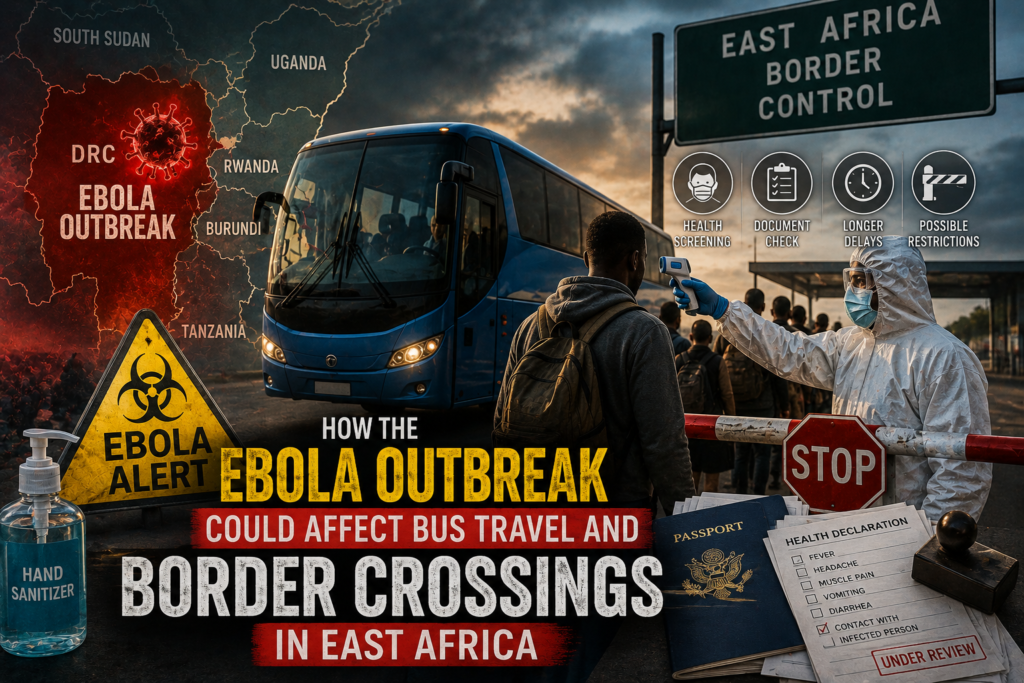
For many travelers in East Africa, crossing borders by bus is normal life.
Every day, thousands of people travel:
- Kigali to Kampala
- Kampala to Nairobi
- Goma to Kigali
- South Sudan to Uganda
- Tanzania to Rwanda
Some travel for business.
Others for family, school, work, or trade.
But right now, something serious is changing the situation across the region:
The Ebola outbreak in the Democratic Republic of Congo (DRC) and Uganda.
And many travelers still do not understand how this could affect:
- border crossings
- bus travel
- immigration procedures
- travel delays
- regional movement.
What Is Happening Right Now?
In May 2026, health authorities officially confirmed a new Ebola outbreak in eastern Democratic Republic of Congo (DRC), especially in Ituri Province near Uganda and South Sudan.
The outbreak involves the rare Bundibugyo strain of Ebola, which currently has:
- no approved vaccine
- no specific licensed treatment.
According to WHO, Africa CDC, Reuters, and CDC reports:
- hundreds of suspected cases have already been reported
- more than 80 deaths were confirmed early in the outbreak
- suspected deaths later rose above 220 in some reports
- Uganda has already confirmed linked cases, including health workers.
The World Health Organization (WHO) officially declared the outbreak a Public Health Emergency of International Concern because of the high regional risk.
Why Travelers Should Pay Attention
Most people hear “Ebola outbreak” and immediately think only about health.
But experienced travelers know:
During outbreaks, travel itself changes.
And not slowly.
Sometimes overnight.
Why Bus Travel Is Especially Affected
East Africa is deeply connected by road transport.
Unlike international flights, bus travel involves:
- multiple stops
- crowded terminals
- long border queues
- close physical contact
- high cross-border movement.
This creates two major effects during outbreaks:
1️⃣ Governments increase border control
2️⃣ Travelers face confusion and delays
What Could Change at Borders?
Health authorities and governments may introduce:
- temperature screening
- health declarations
- travel history checks
- medical questioning
- sanitation requirements
- additional document checks.
Some countries have already strengthened border surveillance and monitoring around DRC routes.
The Problem Most Travelers Don’t Expect
This is important:
The biggest travel problems during outbreaks are not always the disease itself.
Often the real problems become:
- sudden rule changes
- misinformation
- transport confusion
- border delays
- panic.
And this affects bus travelers first.
Why East Africa Is Considered High Risk
According to WHO and Africa CDC, the regional risk is high because East Africa has:
- strong cross-border trade
- busy land borders
- refugee movement
- daily transport corridors
- high population movement.
The outbreak began near important border regions connecting:
- DRC
- Uganda
- South Sudan.
That is why neighboring countries are now on high alert.
How Border Crossings Could Become Slower
Many travelers are used to quick crossings.
But during health emergencies:
- screening procedures increase
- immigration officers become stricter
- questioning may take longer.
This means:
Bus schedules may become unpredictable.
And many travelers do not prepare for this.
A Hidden Problem Many People Ignore
This happens during almost every regional health crisis:
misinformation spreads faster than facts.
People begin sharing:
- fake travel restrictions
- false border rumors
- incorrect requirements
- unverified “updates”.
And travelers make decisions based on panic instead of verified information. Why This Can Become Expensive
When confusion spreads:
- people miss buses
- tickets get lost
- routes change unexpectedly
- transport scams increase.
Some travelers even pay unnecessary money because they believe false information.
Transport Scams May Increase
This is something many people do not see coming.
Whenever there is:
- fear
- uncertainty
- changing border situations
scammers appear.
People may claim:
- “Borders are closing”
- “Only special buses can cross”
- “Prices increased because of Ebola”
- “You need extra payments”.
And frightened travelers may believe them.
What Experienced Travelers Do Differently
Experienced travelers understand something important:
During crises, verified information becomes more valuable than ever.
Instead of depending on rumors:
- they confirm routes
- verify requirements
- check border updates
- prepare early.
What Exactly Is Ebola?
Ebola is a severe viral disease that spreads through:
- direct contact with infected body fluids
- contaminated surfaces
- infected animals
- unsafe burial practices.
Symptoms may include:
- fever
- vomiting
- weakness
- diarrhea
- body pain
- bleeding in severe cases.
The disease can be deadly if not treated quickly.
According to CDC information, some Ebola strains have mortality rates as high as 80–90%.
Why This Outbreak Is More Difficult
Health experts are especially concerned because:
- the Bundibugyo strain has no approved vaccine
- the outbreak is happening in conflict zones
- healthcare systems are under pressure
- attacks on health facilities have disrupted response efforts.
Reuters reported that attacks on Ebola treatment facilities in eastern Congo caused patients to flee into communities, making containment harder.
WHO also warned that the outbreak may already have spread undetected for weeks before official confirmation.
Countries Most Likely to Feel Effects
Travelers should pay close attention to routes involving:
- DRC
- Uganda
- Rwanda
- South Sudan
- Burundi
- Tanzania.
Especially:
- eastern DRC corridors
- Uganda border regions
- high-traffic bus routes.
- What Bus Travelers Should Do Right Now
This is where preparation matters most.✔ Stay Updated Before Traveling
Do not rely on:
- rumors
- WhatsApp forwards
- unverified social media posts.
Follow:
- WHO
- CDC
- Africa CDC
- official government updates.
- ✔ Arrive Earlier Than Normal
Health screening may slow border procedures.
Extra time can prevent:
- missed buses
- panic
- rushed decisions.
- ✔ Carry Proper Hygiene Supplies
Simple protection matters:
- hand sanitizer
- masks if required
- clean tissues
- soap.
- ✔ Avoid Physical Contact in Crowded Areas
Bus terminals and borders can become crowded quickly.
Reducing unnecessary contact lowers risk.✔ Be Careful With “Emergency Transport Offers”
During uncertainty, fake agents often appear.
Always verify:
- bus companies
- ticket prices
- route information.
✔ Monitor Route Changes
Some routes may:
- slow down
- change schedules
- face additional checks.
Always confirm before departure.
One Thing Most Travelers Still Don’t Understand
This is important:
During outbreaks, border situations can change faster than websites update.
That means:
- yesterday’s information may already be outdated today.
And this is exactly where travelers get caught off guard.
Why Preparation Matters More During Outbreaks
Most travel problems do not begin at the border.
They begin before the journey.
Especially when:
- fear spreads
- rumors increase
- rules change quickly.
How TIC Helps Travelers During Situations Like This
At TIC, the goal is not only helping people travel.
It is helping travelers avoid unnecessary problems before they begin.
During situations like the Ebola outbreak, travelers may need help understanding:
- current border situations
- changing transport conditions
- real travel requirements
- safe travel preparation.
Because during uncertainty:
clarity becomes extremely valuable.
Final Warning
The Ebola outbreak is not just a health story anymore.
It is becoming:
- a transport issue
- a border issue
- a travel preparation issue.
And many travelers will only realize this:
after problems begin.
During stable times, travelers can sometimes survive on assumptions.
During outbreaks?
Assumptions become dangerous.
Before You Travel
Do not wait until:
- your bus is delayed
- your route changes
- the border situation surprises you.
Prepare early. Verify information. Travel smart.